
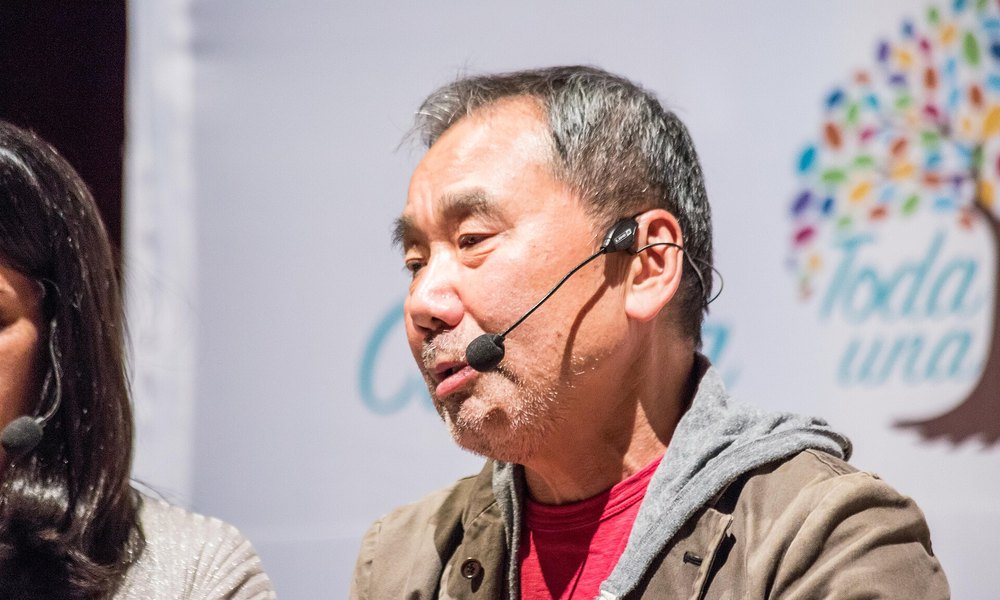
Haruki Murakami is a Japanese novelist, born in Kyoto on 12 January 1949, whose books include “Norwegian Wood”, “The Wind-Up Bird Chronicle”, “Kafka on the Shore” and “1Q84”. His work has been translated into 50 languages and is often described as magical realism.
Murakami was raised in Nishinomiya, Ashiya and Kobe, the only child of two teachers of Japanese literature, and grew up reading European and American writers. He studied drama at Waseda University in Tokyo, and from 1974 to 1981 he and his wife Yoko ran a coffee house and jazz bar called Peter Cat. He began writing fiction at 29, after the idea came to him while watching a baseball game. His first novel, “Hear the Wind Sing” (1979), won the Gunzo Prize for New Writers.
“Pinball, 1973” and “A Wild Sheep Chase” completed what is known as the Trilogy of the Rat, centred on an unnamed narrator and his friend, the Rat. “Dance Dance Dance” (1988) is a later sequel. “Hard-Boiled Wonderland and the End of the World” (1985) won the Tanizaki Prize, and “Norwegian Wood” (1987), a story of loss and sexuality, sold millions of copies in Japan and brought him national recognition.
After that success he travelled through Europe and lived in the United States, where he held writing fellowships at Princeton and Tufts and wrote “South of the Border, West of the Sun” and “The Wind-Up Bird Chronicle”, which won the Yomiuri Prize. He returned to Japan after the Kobe earthquake and the Tokyo subway gas attack, and responded with “Underground”, built on interviews with victims of the attack, and the story collection “After the Quake”. “Kafka on the Shore” won the World Fantasy Award in 2006.
His honours include the Franz Kafka Prize (2006), the Jerusalem Prize (2009) and the Princess of Asturias Award for Literature (2023). Films drawn from his work include “Norwegian Wood” (2010), “Burning” (2018), based on the story “Barn Burning”, and “Drive My Car” (2021), which won the Academy Award for Best International Feature.
“The City and Its Uncertain Walls” (2023) grew from a novella he wrote in 1980. His latest novel, “The Tale of Kaho”, was published in Japan by Shinchosha on 3 July 2026. It follows a 26-year-old picture book author and, according to the publisher, is his first novel with a woman as its sole protagonist.
Publication Order of The Rat Books
| Hear the Wind Sing | 1979 |
| Pinball, 1973 | 1980 |
| A Wild Sheep Chase | 1982 |
| Dance Dance Dance | 1988 |
Publication Order of Standalone Novels
| Hard-Boiled Wonderland and the End of the World | 1985 |
| Norwegian Wood | 1987 |
| South of the Border, West of the Sun | 1992 |
| The Wind-Up Bird Chronicle | 1994 |
| Sputnik Sweetheart | 1999 |
| Kafka on the Shore | 2002 |
| After Dark | 2004 |
| 1Q84 | 2009 |
| Colorless Tsukuru Tazaki and His Years of Pilgrimage | 2013 |
| Killing Commendatore | 2017 |
| The City and Its Uncertain Walls | 2023 |
| The Tale of Kaho | 2026 |
Publication Order of Short Stories/Novellas
| The Strange Library | 2005 |
Publication Order of Short Story Collections
| The Elephant Vanishes | 1993 |
| After the Quake | 2000 |
| Blind Willow, Sleeping Woman | 2006 |
| Men Without Women | 2014 |
| First Person Singular | 2020 |
Publication Order of Non-Fiction Books
| Haruki Murakami Goes to Meet Hayao Kawai | 1996 |
| Underground | 1997 |
| What I Talk About When I Talk About Running | 2007 |
| Absolutely on Music: Conversations | 2011 |
| Novelist as a Vocation | 2015 |
| Abandoning a Cat: Memories of My Father | 2019 |
| Murakami T: The T-Shirts I Love | 2020 |
Photo: Ministerio Cultura y Patrimonio, Ecuador, Public domain, via Wikimedia Commons (cropped).