
Publication Order of Standalone Novels
| Lie Down in Darkness | 1951 |
| The Long March | 1952 |
| Set This House on Fire | 1960 |
| The Confessions of Nat Turner | 1967 |
| Sophie’s Choice | 1979 |
Publication Order of Short Stories/Novellas
| Shadrach | 1979 |
Publication Order of Short Story Collections
| A Tidewater Morning: Three Tales from Youth | 1993 |
| The Suicide Run: Five Tales of the Marine Corps | 2009 |
Publication Order of Plays
| In the Clap Shack | 1973 |
Publication Order of Non-Fiction Books
| This Quiet Dust and Other Writings | 1982 |
| Darkness Visible: A Memoir of Madness | 1990 |
| Havanas in Camelot: Personal Essays | 2008 |
| Letters to My Father | 2009 |
| Selected Letters of William Styron | 2012 |
| My Generation: Collected Nonfiction | 2015 |
About William Styron
William Styron (1925 to 2006) was an American novelist and essayist best known for “The Confessions of Nat Turner”, which won the Pulitzer Prize for Fiction in 1968, for “Sophie’s Choice”, which won the National Book Award in 1980, and for “Darkness Visible”, his memoir of depression.
He was born on 11 June 1925 in Newport News, Virginia, the son of a shipyard engineer, and lost his mother to breast cancer in 1939. After Christchurch School and a spell at Davidson College he transferred to Duke University in 1943 under the Navy and Marine Corps V-12 programme. He was commissioned as a Marine lieutenant, but Japan surrendered before his ship left San Francisco, and he returned to Duke to finish his English degree in 1947. An editing job at McGraw-Hill in New York ended when he was fired, and he turned to his first novel.
“Lie Down in Darkness” (1951), the story of a troubled Virginia family, was widely acclaimed and brought him the Rome Prize. Recalled to the Marines during the Korean War and discharged in 1952, he drew on his time at Camp Lejeune for the short novel “The Long March”. In Paris he belonged to the circle of writers who founded The Paris Review in 1953, the year he married the poet Rose Burgunder in Rome. “Set This House on Fire” (1960) concerns American expatriates on the Amalfi coast.
“The Confessions of Nat Turner” (1967) takes the form of the imagined memoirs of the man who led a slave rebellion in 1831. It was a critical and commercial success, though a number of Black critics attacked its portrayal of Turner, and their objections were gathered in “William Styron’s Nat Turner: Ten Black Writers Respond” (1968). “Sophie’s Choice” (1979) is narrated by Stingo, a young Southern writer in post-war Brooklyn who befriends Sophie, a Polish Catholic survivor of Auschwitz, and her lover Nathan. Meryl Streep won the Academy Award for Best Actress in the 1982 film, and Nicholas Maw’s opera based on the novel opened at the Royal Opera House in 2002.
Styron first suffered serious depression in 1985, and “Darkness Visible” (1990) grew out of a Vanity Fair article about the experience. “A Tidewater Morning” followed in 1993, the year he received the National Medal of Arts. He died of pneumonia on Martha’s Vineyard on 1 November 2006, aged 81. Posthumous books include the essays “Havanas in Camelot” (2008) and “The Suicide Run” (2009), five narratives drawn from his Marine Corps service.
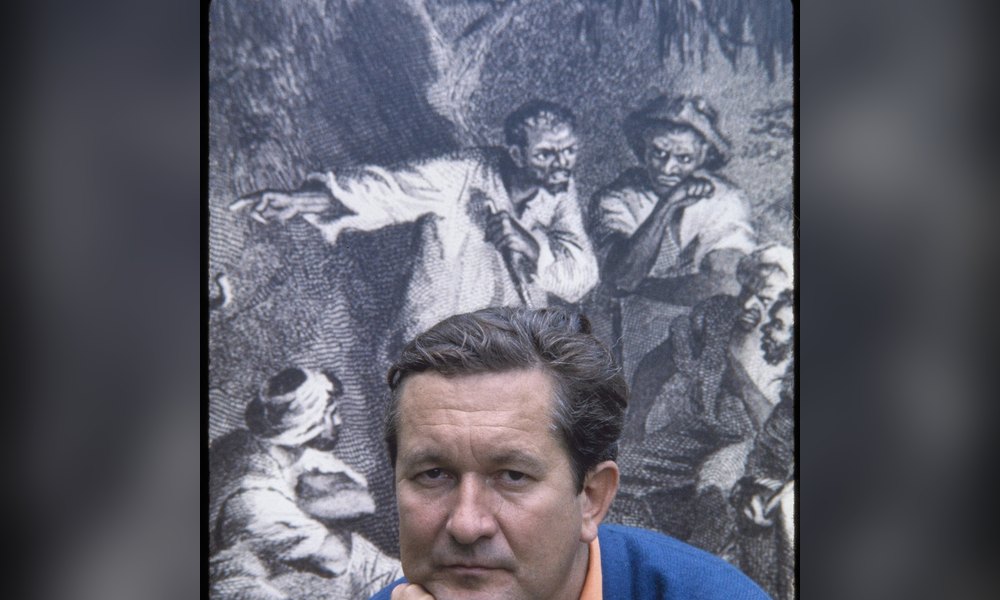
Photo: Bernard Gotfryd / Library of Congress, Public domain, via Wikimedia Commons (cropped).