
Publication Order of Standalone Novels
| Fanshawe | 1828 |
| The Scarlet Letter | 1850 |
| The House of the Seven Gables | 1851 |
| The Blithedale Romance | 1852 |
| The Marble Faun / Transformation | 1860 |
| Septimius Felton; or, The Elixir of Life | 1872 |
| The Dolliver Romance and Other Pieces | 1876 |
| Doctor Grimshawe’s Secret | 1882 |
Publication Order of Short Story Collections
| Twice-Told Tales | 1837 |
| Mosses from an Old Manse | 1846 |
| The Snow-Image, and Other Twice-Told Tales | 1851 |
Publication Order of Children’s Books
| Grandfather’s Chair | 1840 |
| Famous Old People | 1841 |
| Liberty Tree | 1841 |
| Biographical Stories for Children | 1842 |
| A Wonder-Book for Girls and Boys | 1851 |
| Tanglewood Tales | 1853 |
Publication Order of Non-Fiction Books
| Life of Franklin Pierce | 1852 |
| Our Old Home: A Series of English Sketches | 1863 |
| Passages from the American Note-Books | 1868 |
| Passages from the English Note-Books | 1870 |
| Passages from the French and Italian Note-Books | 1871 |
| Twenty Days with Julian & Little Bunny | 1904 |
About Nathaniel Hawthorne
Nathaniel Hawthorne (1804 to 1864) was an American novelist and short story writer, the author of “The Scarlet Letter” (1850) and “The House of the Seven Gables” (1851). Much of his writing centres on New England and its Puritan past, and his fiction is considered part of the Romantic movement and, more specifically, dark romanticism.
He was born Nathaniel Hathorne in Salem, Massachusetts, on 4 July 1804. His great-great-grandfather John Hathorne was one of the judges in the Salem witch trials, and Hawthorne probably added the “w” to his surname in his early twenties. His father, a sea captain, died of yellow fever in 1808. Hawthorne entered Bowdoin College in 1821, where he met the future president Franklin Pierce and the future poet Henry Wadsworth Longfellow, and graduated in 1825.
His first published work, the novel “Fanshawe”, appeared anonymously in 1828 at his own expense; he later tried to suppress it. He published short stories in periodicals and collected them in 1837 as “Twice-Told Tales”. He worked at the Boston Custom House, joined the transcendentalist community at Brook Farm in 1841, and married Sophia Peabody in 1842. The couple moved to The Old Manse in Concord, where he wrote most of the tales in “Mosses from an Old Manse”.
In 1846 Hawthorne was appointed surveyor at the Salem custom house, a post he lost after the presidential election of 1848. “The Scarlet Letter” was published in March 1850 and sold 2,500 copies within ten days. He moved to a farmhouse near Lenox, where he became friends with Herman Melville, who dedicated “Moby-Dick” to him. There he wrote “The House of the Seven Gables”, “The Blithedale Romance”, which draws on his time at Brook Farm, and “A Wonder-Book for Girls and Boys”, a collection of retold myths.
After he wrote a campaign biography of Pierce in 1852, Hawthorne was appointed United States consul in Liverpool in 1853. The post ended in 1857 and the family toured France and Italy before returning to Concord in 1860, the year “The Marble Faun” was published (as “Transformation” in Britain).
Failing health prevented him from completing several more romances. He died in his sleep on 19 May 1864 in Plymouth, New Hampshire, while on a tour of the White Mountains with Pierce, and was buried at Sleepy Hollow Cemetery in Concord. Unfinished works including “Septimius Felton” and “Doctor Grimshawe’s Secret” were published after his death.
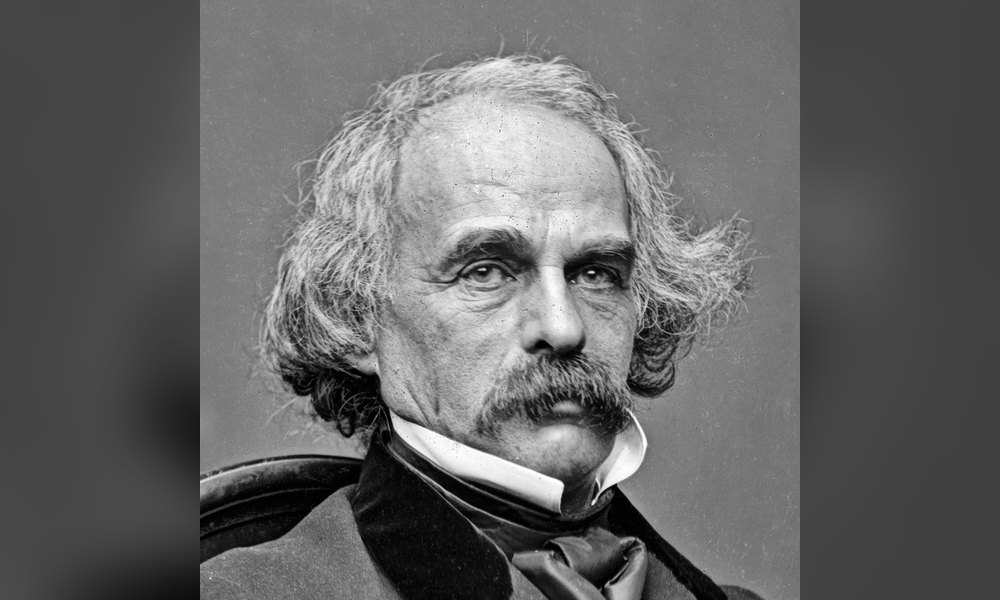
Photo: Mathew Brady / Library of Congress, Public domain, via Wikimedia Commons (cropped).