
Publication Order of Standalone Novels
| Invisible Man | 1952 |
| Juneteenth | 1999 |
| Three Days Before the Shooting... | 2010 |
Publication Order of Short Story Collections
| Flying Home and Other Stories | 1996 |
Publication Order of Non-Fiction Books
| Shadow and Act | 1964 |
| Going to the Territory | 1986 |
| The Collected Essays of Ralph Ellison | 1995 |
| Trading Twelves: The Selected Letters of Ralph Ellison and Albert Murray (With: Albert Murray) | 2000 |
| Living with Music: Ralph Ellison’s Jazz Writings | 2001 |
| The Selected Letters of Ralph Ellison | 2019 |
About Ralph Ellison
Ralph Ellison (1913 to 1994) was an American novelist, essayist and critic, best known for “Invisible Man” (1952), which won the National Book Award for Fiction in 1953. It was the only novel he published in his lifetime; a second, “Juneteenth”, was assembled from his manuscripts and published in 1999.
Ralph Waldo Ellison was born in Oklahoma City on 1 March 1913 and named after Ralph Waldo Emerson. His father, a small-business owner and construction foreman, died in 1916, and Ellison worked from boyhood as a busboy, shoeshine boy and hotel waiter to help support the family. He learned trumpet and saxophone, and in 1933 was admitted to the Tuskegee Institute in Alabama to study music, reaching it by hopping freight trains. There he read T. S. Eliot, Joyce and Dostoevsky in the library, and he left in 1936 without taking a degree.
He moved to New York that year meaning to study sculpture. In Harlem he met Langston Hughes and Richard Wright, and Wright encouraged him to write fiction. Between 1937 and 1944 he published more than 20 book reviews along with stories and articles, served in the Merchant Marine towards the end of the Second World War, and in 1946 married Fanny McConnell, who supported him while he wrote his novel.
“Invisible Man” follows an unnamed African American narrator from the Deep South to the New York of the 1930s as he searches for an identity in a society that refuses to see him. In 1965 a Book Week poll of 200 critics, authors and editors named it the most important novel published since the Second World War.
Ellison followed it with two essay collections, “Shadow and Act” (1964) and “Going to the Territory” (1986), which take in literature, race and jazz. He taught at Bard College, Rutgers, the University of Chicago and New York University, and received the Presidential Medal of Freedom in 1969 and the National Medal of Arts in 1985. He worked on a second novel for some 40 years, writing more than 2,000 pages without finishing it, and said a 1967 house fire had destroyed part of the manuscript.
He died of pancreatic cancer in New York on 16 April 1994. His literary executor, John F. Callahan, edited “Flying Home and Other Stories” (1996) and “Juneteenth”, and the full manuscripts of the unfinished novel appeared in 2010 as “Three Days Before the Shooting...”.
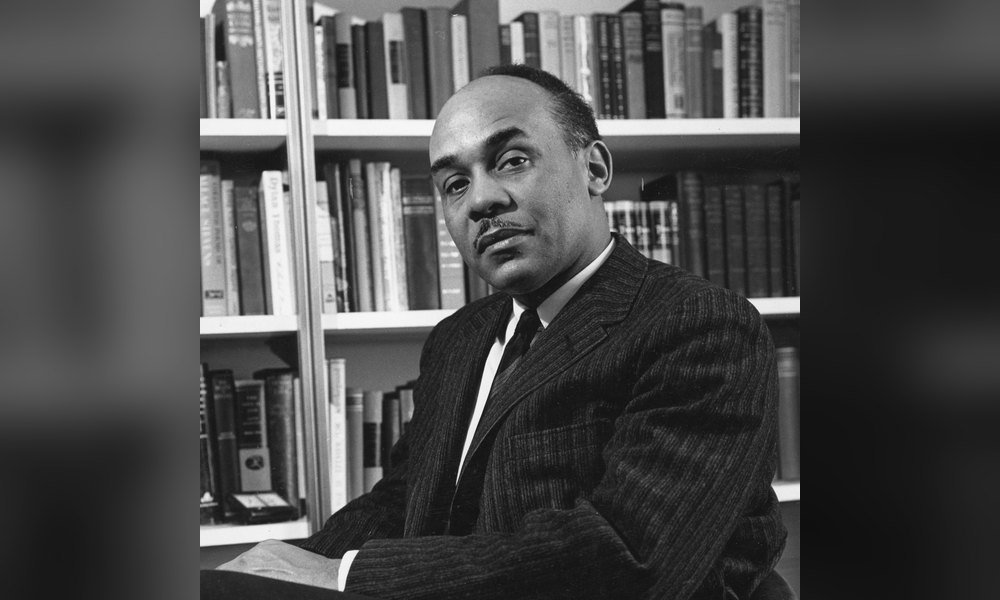
Photo: United States Information Agency staff photographer, Public domain, via Wikimedia Commons (cropped).