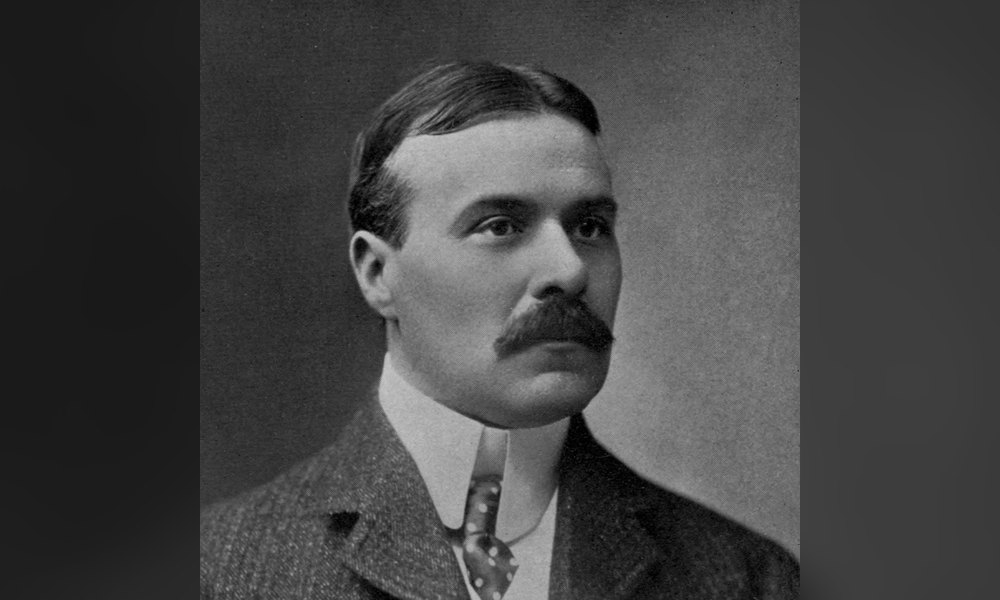
Robert W. Chambers (1865-1933) was an American artist and writer, best known for “The King in Yellow” (1895), a collection of short stories regarded as a classic of supernatural fiction. He went on to become one of the most commercially successful novelists of his day, writing historical fiction and society romances.
Chambers was born in Brooklyn, New York, on 26 May 1865, the son of a corporate lawyer; his brother was the architect Walter B. Chambers. He was educated at the Brooklyn Polytechnic Institute and at the Art Students’ League, where Charles Dana Gibson was a fellow student. From 1886 to 1893 he studied in Paris at the École des Beaux-Arts and the Académie Julian, and his work was shown at the Salon as early as 1889. Back in New York he sold illustrations to Life, Truth and Vogue before turning to writing.
His first novel, “In the Quarter”, appeared in 1894. “The King in Yellow” followed a year later: its opening stories are linked by a fictitious play of the same name that drives its readers insane, and they were admired by H. P. Lovecraft and his circle. Chambers returned to weird fiction in “The Maker of Moons”, “The Mystery of Choice” and “The Tree of Heaven”. “In Search of the Unknown” (1904) and “Police!!!” (1915) are linked stories about a zoologist who encounters monsters.
His historical fiction includes four novels set during the Franco-Prussian War, beginning with “The Red Republic” (1895), and “Cardigan” (1901), set at the outbreak of the American Revolution, which was his most highly praised historical novel in his lifetime. “Special Messenger”, “Ailsa Paige” and “Whistling Cat” are set during the American Civil War. He also wrote romances such as “The Fighting Chance” and “The Common Law”, a handful of which were best-sellers, and war adventure novels during the First World War. After 1924 he wrote only historical fiction.
Many of his novels were filmed in the silent era. D. W. Griffith directed “America” (1924) from a screenplay by Chambers, and “The Common Law” reached the screen in 1916, 1923 and 1931. “The Tracer of Lost Persons” became the radio crime drama “Mr. Keen, Tracer of Lost Persons”, which ran from 1937 to 1954. Chambers died in New York City on 16 December 1933, three days after intestinal surgery, and several of his books were first published in the years that followed.