
Publication Order of Lanny Budd Books
| World’s End | 1940 |
| Between Two Worlds | 1941 |
| Dragon’s Teeth | 1942 |
| Wide Is the Gate | 1943 |
| Presidential Agent | 1944 |
| Dragon Harvest | 1945 |
| A World to Win | 1946 |
| Presidential Mission | 1947 |
| One Clear Call | 1948 |
| O Shepherd, Speak! | 1949 |
| The Return of Lanny Budd | 1953 |
Publication Order of Sylvia Books
| Sylvia | 1913 |
| Sylvia’s Marriage | 1914 |
Publication Order of King Coal Books
| King Coal | 1917 |
| The Coal War | 1976 |
Publication Order of Standalone Novels
| Springtime and Harvest / King Midas | 1901 |
| Prince Hagen | 1903 |
| The Journal of Arthur Stirling | 1903 |
| Manassas / Theirs Be the Guilt | 1904 |
| A Captain of Industry | 1906 |
| The Jungle | 1906 |
| The Overman | 1907 |
| The Metropolis | 1908 |
| The Moneychangers | 1908 |
| Samuel the Seeker | 1910 |
| Love’s Pilgrimage | 1911 |
| Damaged Goods | 1913 |
| Jimmie Higgins | 1919 |
| 100%: The Story of a Patriot / The Spy | 1920 |
| They Call Me Carpenter | 1922 |
| The Millennium | 1924 |
| The Spokesman’s Secretary | 1926 |
| Oil! | 1927 |
| Boston | 1928 |
| Mountain City | 1930 |
| Roman Holiday | 1931 |
| The Wet Parade | 1931 |
| Co-op | 1936 |
| No Pasaran! | 1937 |
| The Flivver King | 1937 |
| Little Steel | 1938 |
| Our Lady | 1938 |
| Another Pamela | 1950 |
| What Didymus Did / It Happened to Didymus | 1954 |
| Affectionately Eve | 1961 |
Publication Order of Children’s Books
| The Gnomobile | 1936 |
Publication Order of Non-Fiction Books
| The Industrial Republic | 1907 |
| Good Health and How We Won It (With: Michael Williams) | 1909 |
| The Fasting Cure | 1911 |
| The Profits of Religion | 1917 |
| The Brass Check | 1919 |
| The Book of Life | 1921 |
| The Goose-Step | 1923 |
| The Goslings | 1924 |
| Mammonart | 1925 |
| Letters to Judd | 1925 |
| Money Writes! | 1927 |
| Mental Radio | 1930 |
| American Outpost | 1932 |
| Upton Sinclair Presents William Fox | 1933 |
| The Way Out | 1933 |
| I, Governor of California, and How I Ended Poverty | 1933 |
| The EPIC Plan for California | 1934 |
| I, Candidate for Governor: And How I Got Licked | 1935 |
| What God Means to Me | 1936 |
| A Personal Jesus | 1952 |
| The Cup of Fury | 1956 |
| My Lifetime in Letters | 1960 |
| The Autobiography of Upton Sinclair | 1962 |
About Upton Sinclair
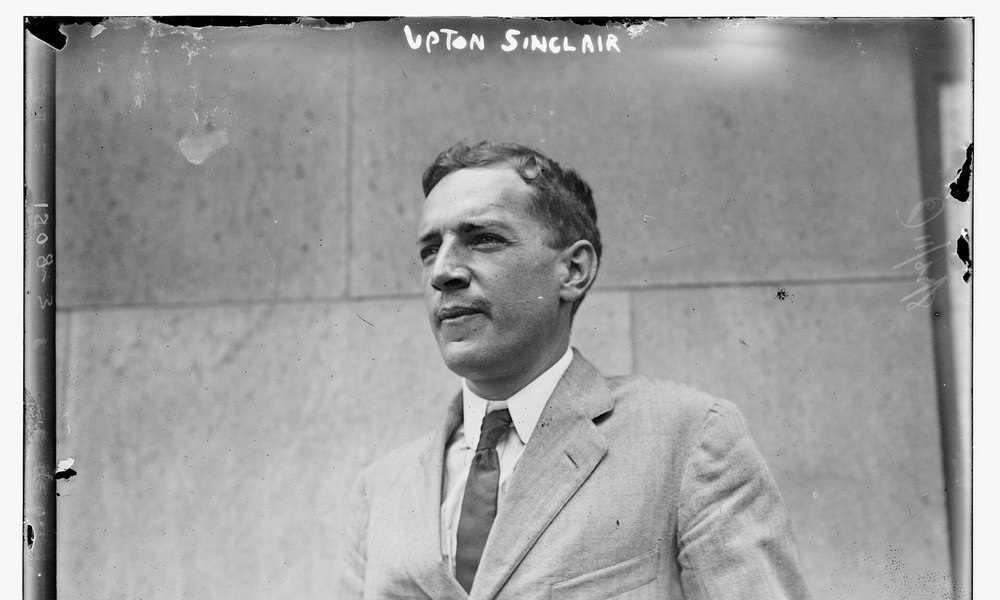
Upton Sinclair (1878 to 1968) was an American novelist, muckraking journalist and socialist campaigner who wrote nearly 100 books. He is best known for “The Jungle” (1906), his novel about Chicago’s meatpacking plants, for “Oil!” (1927), and for the eleven Lanny Budd novels, the third of which, “Dragon’s Teeth”, won the Pulitzer Prize in 1943.
Sinclair was born in Baltimore, the son of a liquor salesman whose drinking shadowed his childhood, while his mother’s relatives were wealthy. Moving between the two households gave him an early view of how both rich and poor lived. He entered the City College of New York shortly before his fourteenth birthday and paid his way by writing jokes, dime novels and boys’ adventure stories for pulp magazines. His first four serious books, from “King Midas” (1901) to the Civil War novel “Manassas” (1904), sold poorly.
In 1904 he spent seven weeks working undercover in the Chicago stockyards. The result, “The Jungle”, follows a Lithuanian immigrant, Jurgis Rudkus, and his family. It ran as a serial in the socialist paper “Appeal to Reason” in 1905 before Doubleday published it as a book. The public outcry helped bring about the Meat Inspection Act and the Pure Food and Drug Act later in 1906.
He went on writing novels about American industries: “King Coal” (1917), on the Colorado coalfields, “Oil!”, written against the background of the Teapot Dome scandal, and “The Flivver King” (1937), on Henry Ford. “Boston” (1928) is a documentary novel about the Sacco and Vanzetti case. His non-fiction includes “The Brass Check” (1919), an attack on American journalism. “The Wet Parade” was filmed in 1932, his children’s story “The Gnomobile” became a Disney film in 1967, and “Oil!” was the basis of “There Will Be Blood” (2007).
Sinclair ran for office several times as a Socialist and in 1934 was the Democratic candidate for governor of California on his End Poverty in California platform, losing to Frank Merriam. He then returned to writing. Between 1940 and 1953 he published the Lanny Budd series, in which the son of an American arms manufacturer moves among world leaders through the main political events of the first half of the twentieth century. A sequel to “King Coal”, “The Coal War”, was rejected in 1917 and first published in 1976, eight years after his death.
Photo: Bain News Service / Library of Congress, Public domain, via Wikimedia Commons (cropped).