
Publication Order of Three Californias Books
| The Wild Shore | 1984 |
| The Gold Coast | 1988 |
| Pacific Edge | 1990 |
Publication Order of Mars Trilogy Books
| Red Mars | 1992 |
| Green Mars | 1993 |
| Blue Mars | 1996 |
| The Martians | 1999 |
Publication Order of Science in the Capital Books
| Forty Signs of Rain | 2004 |
| Fifty Degrees Below | 2005 |
| Sixty Days and Counting | 2007 |
Publication Order of Standalone Novels
| Icehenge | 1984 |
| The Memory of Whiteness | 1985 |
| A Short, Sharp Shock | 1990 |
| Antarctica | 1997 |
| The Years of Rice and Salt | 2002 |
| Galileo’s Dream | 2009 |
| 2312 | 2012 |
| Shaman | 2013 |
| Aurora | 2015 |
| New York 2140 | 2017 |
| Red Moon | 2018 |
| The Ministry for the Future | 2020 |
Publication Order of Short Stories/Novellas
| The Lucky Strike | 1984 |
| Green Mars (Novella) | 1985 |
| The Blind Geometer | 1986 |
Publication Order of Short Story Collections
| The Planet on the Table | 1986 |
| Escape from Kathmandu | 1989 |
| Remaking History | 1991 |
| Down and Out in the Year 2000 | 1992 |
| Vinland the Dream and Other Stories | 2002 |
| The Best of Kim Stanley Robinson | 2010 |
Publication Order of Non-Fiction Books
| The Novels of Philip K. Dick | 1984 |
| The High Sierra: A Love Story | 2022 |
| The Best Journey in the World: An Antarctic Story | 2026 |
About Kim Stanley Robinson
Kim Stanley Robinson (born 1952) is an American science fiction writer best known for the Mars trilogy, about the settlement and terraforming of Mars. His novels often deal with ecology, politics and climate change, and they have won the Hugo, Nebula and Locus awards.
Robinson was born in Waukegan, Illinois, on 23 March 1952 and moved to Southern California as a child. He took a BA in literature at the University of California, San Diego in 1974 and an MA in English at Boston University in 1975, then returned to San Diego for a PhD in English, awarded in 1982. His dissertation, on the novels of Philip K. Dick, was begun under the critic Fredric Jameson. He lives in Davis, California, and is a keen backpacker in the Sierra Nevada.
His first novels, “Icehenge” and “The Wild Shore”, both appeared in 1984. “The Wild Shore” won the Locus Award for best first novel and opened the Three Californias trilogy, which imagines three different futures for Orange County, California. Its final volume, “Pacific Edge”, won the John W. Campbell Memorial Award.
The Mars trilogy consists of “Red Mars” (1992), “Green Mars” (1993) and “Blue Mars” (1996), and follows a large cast of characters across 187 years, from 2026 to 2212. “Red Mars” won the BSFA and Nebula awards, and the two later volumes each won both the Hugo and the Locus award. “The Martians” (1999) collects short stories in the same setting.
Later books include “The Years of Rice and Salt” (2002), an alternate history in which the Black Death kills 99 per cent of Europe’s population, and the Science in the Capital trilogy, set in a Washington, D.C. affected by climate change. “2312” won the Nebula Award for best novel in 2013, and “New York 2140” (2017) is set in a city half submerged by a 50-foot rise in sea level. “The Ministry for the Future” (2020) follows a body set up under the Paris Agreement to speak for future generations.
His recent books are non-fiction. “The High Sierra: A Love Story” appeared in 2022. “The Best Journey in the World: An Antarctic Story”, an account of his Antarctic travels, is due from Little, Brown on 1 December 2026.
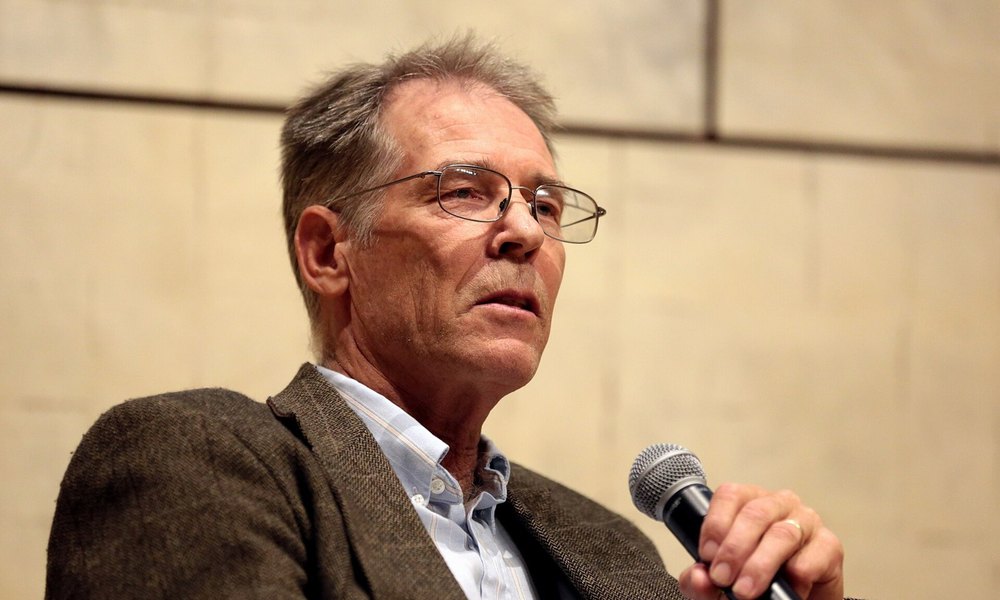
Photo: Gage Skidmore, CC BY-SA 2.0, via Wikimedia Commons (cropped).