
Publication Order of Standalone Novels
| Desperate Remedies | 1871 |
| Under the Greenwood Tree | 1872 |
| A Pair of Blue Eyes | 1873 |
| Far from the Madding Crowd | 1874 |
| The Hand of Ethelberta | 1876 |
| The Return of the Native | 1878 |
| The Trumpet-Major | 1880 |
| A Laodicean | 1881 |
| Two on a Tower | 1882 |
| The Mayor of Casterbridge | 1886 |
| The Woodlanders | 1887 |
| Tess of the d’Urbervilles | 1891 |
| Jude the Obscure | 1895 |
| The Well-Beloved | 1897 |
Publication Order of Short Story Collections
| Wessex Tales | 1888 |
| A Group of Noble Dames | 1891 |
| Life’s Little Ironies | 1894 |
| A Changed Man and Other Tales | 1913 |
Publication Order of Poetry Collections
| Wessex Poems and Other Verses | 1898 |
| Poems of the Past and the Present | 1901 |
| Time’s Laughingstocks and Other Verses | 1909 |
| Satires of Circumstance | 1914 |
| Moments of Vision | 1917 |
| Late Lyrics and Earlier | 1922 |
| Human Shows, Far Phantasies, Songs and Trifles | 1925 |
| Winter Words in Various Moods and Metres | 1928 |
Publication Order of Plays
| The Dynasts, Part 1 | 1904 |
| The Dynasts, Part 2 | 1906 |
| The Dynasts, Part 3 | 1908 |
| The Famous Tragedy of the Queen of Cornwall | 1923 |
About Thomas Hardy
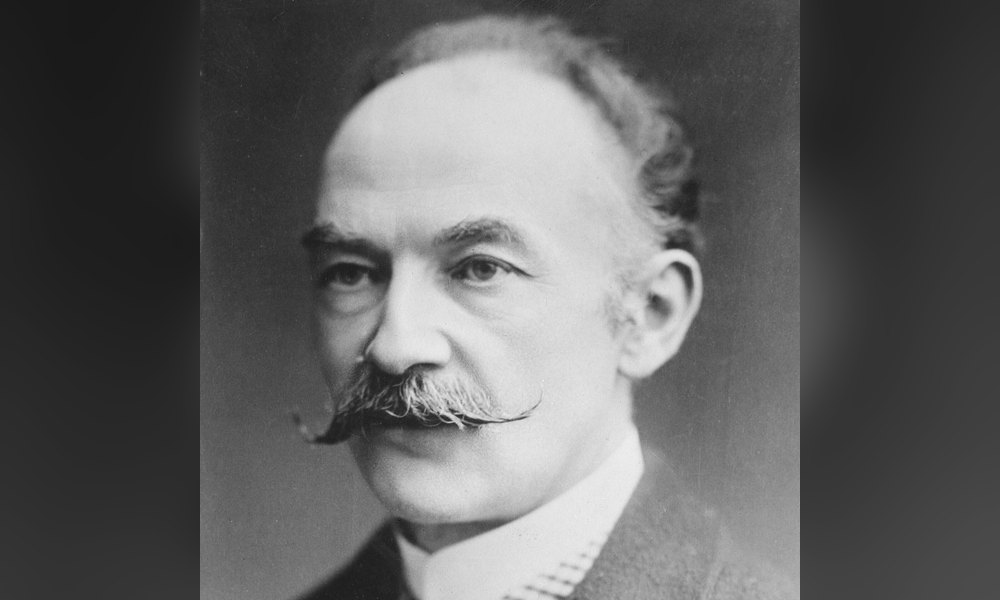
Thomas Hardy (2 June 1840 to 11 January 1928) was an English novelist and poet whose fiction is set in Wessex, a semi-fictional version of south-west England. He is the author of fourteen published novels, among them “Far from the Madding Crowd”, “The Mayor of Casterbridge”, “Tess of the d’Urbervilles” and “Jude the Obscure”, and of eight volumes of verse.
Hardy was born at Higher Bockhampton in Dorset, where his father worked as a stonemason and builder. His formal education ended at sixteen, when he was apprenticed to a local architect, James Hicks. In 1862 he moved to London and joined the practice of Arthur Blomfield as an assistant architect. After five years he returned to Dorset and decided to dedicate himself to writing.
His first novel, “The Poor Man and the Lady”, failed to find a publisher and he later destroyed the manuscript. “Desperate Remedies” (1871) and “Under the Greenwood Tree” (1872) were published anonymously, and “A Pair of Blue Eyes” (1873) appeared under his own name. “Far from the Madding Crowd” (1874), in which he first used the name Wessex, was successful enough for him to give up architecture. He married Emma Gifford the same year, and in 1885 they moved to Max Gate, a house in Dorchester that he designed himself.
Many of the novels concern tragic characters struggling against their passions and social circumstances. “Tess of the d’Urbervilles” (1891) was criticised for its sympathetic portrayal of a “fallen woman”, and “Jude the Obscure” (1895), the last novel he wrote, met an even stronger negative response for its treatment of sex, religion and marriage. “The Well-Beloved”, serialised in 1892, was the last to be published as a book, in 1897.
Hardy regarded himself primarily as a poet. His first collection, “Wessex Poems”, came out in 1898, and in the twentieth century he published only poetry, including the three-part verse drama “The Dynasts” (1904 to 1908). He was appointed to the Order of Merit in 1910 and died at Max Gate in 1928. His ashes were placed in Poets’ Corner in Westminster Abbey and his heart was buried at Stinsford.
Screen versions of his novels include John Schlesinger’s “Far from the Madding Crowd” (1967) with Julie Christie, Roman Polanski’s “Tess” (1979), which won three Academy Awards, Michael Winterbottom’s “Jude” (1996), and Thomas Vinterberg’s “Far from the Madding Crowd” (2015) with Carey Mulligan.
Photo: Bain News Service / Library of Congress, Public domain, via Wikimedia Commons (cropped).