Why the Little Frenchman Wears His Hand in a Sling
1840
The Business Man
1840
The Man of the Crowd
1840
A Descent into the Maelström
1841
The Island of the Fay
1841
The Colloquy of Monos and Una
1841
Never Bet the Devil Your Head
1841
Eleonora
1841
Three Sundays in a Week
1841
The Oval Portrait
1842
The Masque of the Red Death
1842
The Landscape Garden
1842
The Pit and the Pendulum
1842
The Tell-Tale Heart
1843
The Gold-Bug
1843
The Black Cat
1843
Diddling
1843
The Spectacles
1844
A Tale of the Ragged Mountains
1844
The Premature Burial
1844
Mesmeric Revelation
1844
The Oblong Box
1844
The Angel of the Odd
1844
Thou Art the Man
1844
The Literary Life of Thingum Bob, Esq.
1844
The Balloon-Hoax
1844
The Thousand-and-Second Tale of Scheherazade
1845
Some Words with a Mummy
1845
The Power of Words
1845
The Imp of the Perverse
1845
The System of Doctor Tarr and Professor Fether
1845
The Facts in the Case of M. Valdemar
1845
The Sphinx
1846
The Cask of Amontillado
1846
The Domain of Arnheim
1847
Mellonta Tauta
1849
Hop-Frog
1849
Von Kempelen and His Discovery
1849
X-ing a Paragrab
1849
Landor’s Cottage
1849
Publication Order of Short Story Collections
Tales of the Grotesque and Arabesque
1839
The Prose Romances of Edgar A. Poe
1843
Tales
1845
Publication Order of Poetry Collections
Tamerlane and Other Poems
1827
Al Aaraaf, Tamerlane and Minor Poems
1829
Poems
1831
The Raven and Other Poems
1845
Publication Order of Poems
Tamerlane
1827
Song
1827
Imitation
1827
A Dream
1827
The Lake
1827
Spirits of the Dead
1827
Evening Star
1827
Dreams
1827
Stanzas
1827
The Happiest Day
1827
To the River
1829
Romance
1829
Fairy-Land
1829
To Science
1829
Al Aaraaf
1829
To Helen
1831
A Paean
1831
The Sleeper
1831
The City in the Sea
1831
The Valley of Unrest
1831
Israfel
1831
Enigma
1833
Fanny
1833
The Coliseum
1833
Serenade
1833
To One in Paradise
1834
Hymn
1835
To Elizabeth
1835
Latin Hymn
1836
Bridal Ballad
1837
To Zante
1837
The Haunted Palace
1839
Silence: A Sonnet
1840
Lines on Joe Locke
1843
The Conqueror Worm
1843
Lenore
1843
Dream-Land
1844
Impromptu. To Kate Carol
1845
To F / To Frances
1845
Eulalie
1845
Epigram for Wall Street
1845
The Raven
1845
The Divine Right of Kings
1845
A Valentine
1846
To M. L. S
1847
Ulalume
1847
To Marie Louise
1848
An Enigma
1848
To Helen
1848
A Dream Within a Dream
1849
Eldorado
1849
For Annie
1849
To My Mother
1849
Annabel Lee
1849
The Bells
1849
Publication Order of Non-Fiction Books
The Conchologist’s First Book
1839
Eureka: A Prose Poem
1848
About Edgar Allan Poe
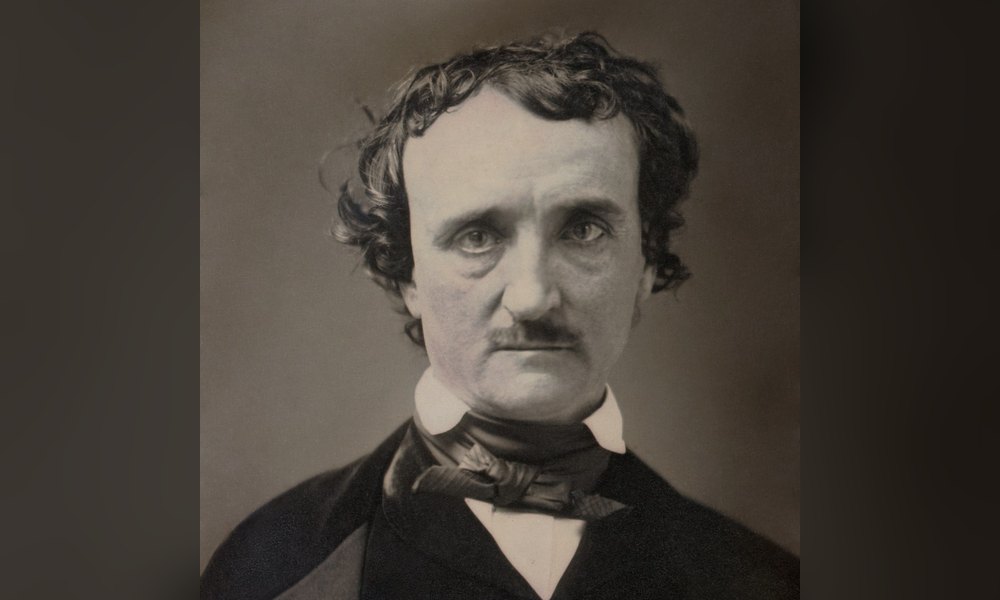
Edgar Allan Poe (1809 to 1849) was an American writer, poet, editor and literary critic, best known for his poetry and for short stories of mystery and the macabre. He is generally considered a pioneer of detective fiction and an early contributor to science fiction, and he was one of the first American writers to succeed with the short story.
Poe was born in Boston on 19 January 1809, the second child of the actors David and Eliza Poe. His father abandoned the family in 1810 and his mother died the following year, after which he was taken in by John and Frances Allan of Richmond, Virginia, who never formally adopted him. He attended the University of Virginia but left after a year for lack of money. In 1827 he enlisted in the United States Army under the name Edgar A. Perry and published his first collection, “Tamerlane and Other Poems”, credited only to “a Bostonian”. He later failed as an officer cadet at West Point.
He then turned to prose, publishing his first tale, “Metzengerstein”, in 1832, and spent years working for literary journals in Baltimore, Philadelphia and New York, where he became known for his criticism. In 1836 he married his cousin Virginia Clemm, who died of tuberculosis in 1847. His only complete novel, “The Narrative of Arthur Gordon Pym of Nantucket”, was issued in 1838.
“The Murders in the Rue Morgue” (1841) introduced the detective C. Auguste Dupin and is considered the first modern detective story. Dupin returned in “The Mystery of Marie Rogêt” and “The Purloined Letter”. “The Gold-Bug” won a $100 prize and was his most widely read prose work during his lifetime. The poem “The Raven” made him a household name in 1845, although it was not a financial success.
Poe died in Baltimore on 7 October 1849, aged 40, and the cause of his death remains unknown. “Annabel Lee” and “The Bells” had been sold before he died and were published afterwards. Several of his homes are now museums, and the Mystery Writers of America present the annual Edgar Award, named after him, for distinguished work in the mystery genre.