
Publication Order of Standalone Novels
| The Time Machine | 1895 |
| The Wonderful Visit | 1895 |
| The Island of Doctor Moreau | 1896 |
| The Wheels of Chance | 1896 |
| The Invisible Man | 1897 |
| The War of the Worlds | 1898 |
| When the Sleeper Wakes / The Sleeper Awakes | 1899 |
| Love and Mr Lewisham | 1900 |
| The First Men in the Moon | 1901 |
| The Sea Lady | 1902 |
| The Food of the Gods and How It Came to Earth | 1904 |
| Kipps | 1905 |
| A Modern Utopia | 1905 |
| In the Days of the Comet | 1906 |
| The War in the Air | 1908 |
| Tono-Bungay | 1909 |
| Ann Veronica | 1909 |
| The History of Mr Polly | 1910 |
| The New Machiavelli | 1911 |
| Marriage | 1912 |
| The Passionate Friends | 1913 |
| The Wife of Sir Isaac Harman | 1914 |
| The World Set Free | 1914 |
| Bealby | 1915 |
| Boon | 1915 |
| The Research Magnificent | 1915 |
| Mr Britling Sees It Through | 1916 |
| The Soul of a Bishop | 1917 |
| Joan and Peter | 1918 |
| The Undying Fire | 1919 |
| The Secret Places of the Heart | 1922 |
| Men Like Gods | 1923 |
| The Dream | 1924 |
| Christina Alberta’s Father | 1925 |
| The World of William Clissold | 1926 |
| Meanwhile | 1927 |
| Mr Blettsworthy on Rampole Island | 1928 |
| The Autocracy of Mr Parham | 1930 |
| The Bulpington of Blup | 1932 |
| The Shape of Things to Come | 1933 |
| The Croquet Player | 1936 |
| Brynhild | 1937 |
| Star Begotten | 1937 |
| The Camford Visitation | 1937 |
| Apropos of Dolores | 1938 |
| The Brothers | 1938 |
| The Holy Terror | 1939 |
| Babes in the Darkling Wood | 1940 |
| All Aboard for Ararat | 1940 |
| You Can’t Be Too Careful | 1941 |
Publication Order of Short Story Collections
| The Stolen Bacillus and Other Incidents | 1895 |
| The Plattner Story and Others | 1897 |
| Thirty Strange Stories | 1897 |
| Tales of Space and Time | 1899 |
| Twelve Stories and a Dream | 1903 |
| The Country of the Blind and Other Stories | 1911 |
| The Door in the Wall and Other Stories | 1911 |
| The Short Stories of H.G. Wells / The Complete Short Stories of H.G. Wells | 1927 |
| The Man with the Nose and Other Uncollected Stories of H.G. Wells | 1984 |
Publication Order of Non-Fiction Books
| Anticipations | 1901 |
| Mankind in the Making | 1903 |
| The Future in America | 1906 |
| First and Last Things | 1908 |
| New Worlds for Old | 1908 |
| Floor Games | 1911 |
| Little Wars | 1913 |
| The War That Will End War | 1914 |
| God the Invisible King | 1917 |
| The Outline of History | 1920 |
| Russia in the Shadows | 1920 |
| A Short History of the World | 1922 |
| The Open Conspiracy / What Are We to Do with Our Lives? | 1928 |
| The Science of Life (With: Julian S. Huxley, G.P. Wells) | 1930 |
| The Work, Wealth and Happiness of Mankind | 1931 |
| Experiment in Autobiography | 1934 |
| World Brain | 1938 |
| The New World Order | 1940 |
| The Rights of Man | 1940 |
| Crux Ansata | 1943 |
| Mind at the End of Its Tether | 1945 |
About H.G. Wells
H.G. Wells (21 September 1866 to 13 August 1946) was an English writer of more than forty novels and dozens of short stories, best known for early science fiction such as “The Time Machine”, “The Invisible Man” and “The War of the Worlds”. He also wrote realist novels of English life and a large body of non-fiction on history, politics and science.
Herbert George Wells was born in Bromley, Kent, the fourth and last child of Joseph Wells, a shopkeeper and professional cricketer, and Sarah Neal, a former domestic servant. From 1880 to 1883 he served an unhappy apprenticeship as a draper in Southsea, an experience that later fed into “The Wheels of Chance”, “Kipps” and “The History of Mr Polly”. He won a scholarship to the Normal School of Science in London, where he studied biology under Thomas Henry Huxley, and in 1888 the school journal printed “The Chronic Argonauts”, a precursor of “The Time Machine”.
His early novels, known as scientific romances, came out in quick succession: “The Time Machine” (1895), “The Island of Doctor Moreau” (1896), “The Invisible Man” (1897), “The War of the Worlds” (1898), “When the Sleeper Wakes” (1899) and “The First Men in the Moon” (1901). They brought time travel, alien invasion, invisibility and biological engineering into fiction before those subjects were common in the genre.
Wells then turned to novels of social realism, among them “Kipps” (1905), “Tono-Bungay” (1909) and “The History of Mr Polly” (1910), which describe lower-middle-class English life. “The World Set Free” (1914) contains the first description of a nuclear weapon, which he called an atomic bomb. “Anticipations” (1901) was his first non-fiction bestseller, and “The Outline of History” followed in 1920. In later years he wrote less fiction and more books setting out his political and social views.
He was nominated for the Nobel Prize in Literature four times and in 1934 co-founded the Diabetic Association, now Diabetes UK. His last novel, “You Can’t Be Too Careful”, was published in 1941, and he died at his home overlooking Regent’s Park in London in 1946.
Film versions of his work include “The Invisible Man” (1933), “Things to Come” (1936), which Wells wrote himself from “The Shape of Things to Come”, “The War of the Worlds” (1953 and 2005) and “The Time Machine” (1960 and 2002, the second directed by his great-grandson Simon Wells). Orson Welles broadcast a famous radio adaptation of “The War of the Worlds” in 1938.
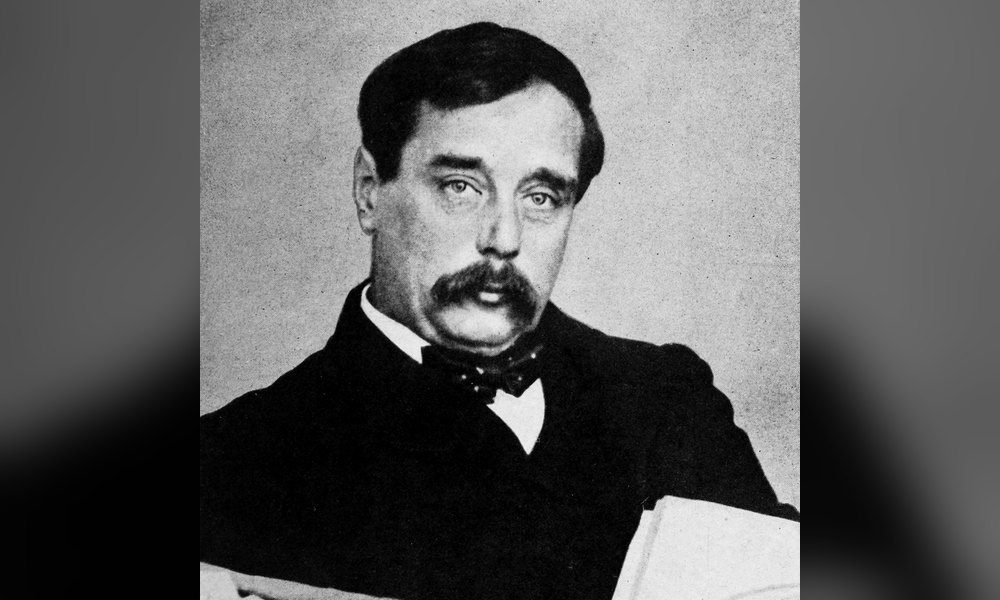
Photo: Unknown photographer, c. 1918 (Daily Mirror); from Secrets of Crewe House, via Internet Archive, Public domain, via Wikimedia Commons (cropped).