Publication Order of The Science of Discworld Books
The Science of Discworld (With: Ian Stewart, Jack Cohen)
1999
The Science of Discworld II: The Globe (With: Ian Stewart, Jack Cohen)
2002
The Science of Discworld III: Darwin’s Watch (With: Ian Stewart, Jack Cohen)
2005
The Science of Discworld IV: Judgement Day (With: Ian Stewart, Jack Cohen)
2013
Publication Order of Bromeliad Trilogy Books
Truckers
1989
Diggers
1990
Wings
1990
Publication Order of Johnny Maxwell Books
Only You Can Save Mankind
1992
Johnny and the Dead
1993
Johnny and the Bomb
1996
Publication Order of The Long Earth Books
The Long Earth (With: Stephen Baxter)
2012
The Long War (With: Stephen Baxter)
2013
The Long Mars (With: Stephen Baxter)
2014
The Long Utopia (With: Stephen Baxter)
2015
The Long Cosmos (With: Stephen Baxter)
2016
Publication Order of Standalone Novels
The Carpet People
1971
The Dark Side of the Sun
1976
Strata
1981
Good Omens (With: Neil Gaiman)
1990
Nation
2008
Dodger
2012
Publication Order of Short Story Collections
Once More* with Footnotes
2004
A Blink of the Screen
2012
A Stroke of the Pen: The Lost Stories
2023
Publication Order of Children’s Books
Where’s My Cow?
2005
The World of Poo
2012
Dragons at Crumbling Castle
2014
The Witch’s Vacuum Cleaner
2016
Father Christmas’s Fake Beard
2017
The Time-Travelling Caveman
2020
Publication Order of Non-Fiction Books
The Unadulterated Cat
1989
The Discworld Companion (With: Stephen Briggs)
1994
Nanny Ogg’s Cookbook (With: Stephen Briggs, Tina Hannan)
1999
The Discworld Almanak (With: Bernard Pearson)
2004
The Art of Discworld (With: Paul Kidby)
2004
The Folklore of Discworld (With: Jacqueline Simpson)
2008
The Compleat Ankh-Morpork
2012
Dodger’s Guide to London
2013
A Slip of the Keyboard
2014
Mrs Bradshaw’s Handbook
2014
The Compleat Discworld Atlas
2015
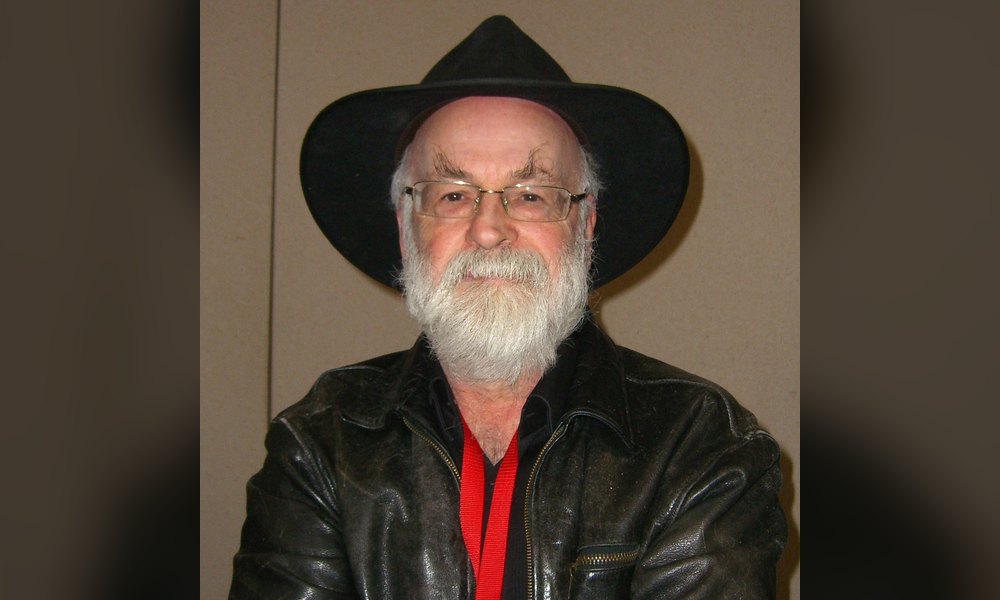
About Terry Pratchett
Sir Terry Pratchett (1948 to 2015) was an English author and satirist, best known for the 41 comic fantasy novels of the “Discworld” series, published between 1983 and 2015, and for “Good Omens” (1990), which he wrote with Neil Gaiman. His books have sold more than 100 million copies in 43 languages.
Born in Beaconsfield, Buckinghamshire, Pratchett had a story published commercially in “Science Fantasy” magazine at 15 and left school at 17 for an apprenticeship on the Bucks Free Press. His first novel, “The Carpet People”, came out in 1971. Two science fiction novels, “The Dark Side of the Sun” (1976) and “Strata” (1981), followed while he worked as a journalist and then as a press officer for the Central Electricity Generating Board.
“The Colour of Magic” (1983) introduced the Discworld, a flat world resting on four elephants that stand on the giant turtle Great A’Tuin. Pratchett became a full-time writer in 1987 after finishing “Mort”, and for years he produced two books annually. The novels were published as one continuous series but fall into groups following the wizards of Unseen University, the witches, Death, the Ankh-Morpork City Watch and the trainee witch Tiffany Aching. He was the UK’s best-selling author of the 1990s.
His children’s fiction includes the Nome trilogy (also called the Bromeliad), the Johnny Maxwell books and “The Amazing Maurice and His Educated Rodents”, which won the 2001 Carnegie Medal. He was appointed OBE in 1998, knighted for services to literature in 2009 and given the World Fantasy Award for Life Achievement in 2010. Sky One made television films of “Hogfather”, “The Colour of Magic” and “Going Postal”, and an animated feature, “The Amazing Maurice”, was released in 2022.
In December 2007 Pratchett announced that he had early-onset Alzheimer’s disease. He kept writing by dictation, made three BBC programmes about the condition and co-wrote the five “Long Earth” novels with Stephen Baxter. He died at home on 12 March 2015, aged 66, and the last Discworld novel, “The Shepherd’s Crown”, was published that August. “A Stroke of the Pen” (2023) gathered 20 early stories he had written for newspapers under pseudonyms.