Publication Order of Derek Calver Adventures Books
The Rim of Space
(1961)
The Ship from Outside
(1963)
Publication Order of Grimes in the Rim World Books
Into the Alternate Universe
(1964)
Contraband from Otherspace
(1967)
The Rim Gods
(1968)
The Dark Dimensions
(1971)
Gateway to Never
(1972)
The Way Back
(1978)
The Commodore at Sea / Alternate Orbits
Publication Order of Empress Books
Empress of Outer Space
(1965)
Space Mercenaries
(1965)
Nebula Alert
(1969)
Publication Order of Grimes in Federation Service Books
The Road To The Rim
(1967)
False Fatherland / Spartan Planet
(1968)
To Prime the Pump
(1971)
The Inheritors
(1972)
The Big Black Mark
(1975)
The Broken Cycle
(1975)
Star Courier
(1977)
Publication Order of John Grimes Saga Books
To the Galactic Rim
(2011)
First Command
(2011)
Galactic Courier
(2011)
Ride the Star Winds
(2012)
Upon a Sea of Stars
(2014)
Publication Order of Standalone Novels
Bring Back Yesterday
(1961)
The Hamelin Plague
(1963)
The Coils of Time
(1964)
Glory Planet
(1964)
The Alternate Martians
(1965)
The Sea Beasts
(1971)
When the Dream Dies
(1981)
Frontier of the Dark
(1984)
Kelly Country
(1985)
Publication Order of Short Stories/Novellas
Wet Paint
(1959)
Raiders of the Solar Frontier
(2011)
Publication Order of Short Story Collections
Beyond the Galactic Rim
(1963)
The Hard Way Up
(1972)
Up to the Sky in Ships
(2015)
Publication Order of Anthologies
Astounding Science Fiction, February 1946
(1946)
Science Fiction Vol. 9 No. 25
(1957)
The Magazine of Fantasy and Science Fiction, May 1959
(1959)
Great Short Novels of Science Fiction
(1970)
SF Authors’ Choice 2
(1970)
The Astounding-Analog Reader, Book Two
(1973)
Other Worlds
(1978)
The Best Australian Science Fiction
(2005)
Worst Contact
(2016)
Out of this World Adventures, July 1950
(2016)
Out of this World Adventures, December 1950
(2016)
Vanguard Science Fiction, June 1958
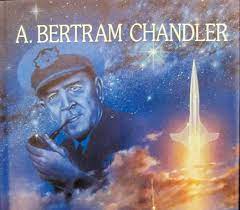
About A. Bertram Chandler
Arthur Bertram Chandler, known to the literary world as A. Bertram Chandler, holds a unique place in the annals of science fiction. Born in England on March 28, 1912, and later moving to Australia, Chandler’s dual career as a merchant marine officer and a writer provided him with a distinctive perspective that enriched his science fiction narratives.
Chandler’s journey into the realm of science fiction began in the 1940s. Unlike many of his contemporaries, his deep understanding of the sea and ships translated seamlessly into his depiction of space and starships. This nautical influence is a defining characteristic of his work, setting him apart in a genre often dominated by writers with backgrounds in physics or engineering.
Perhaps his most famous creation is John Grimes, the protagonist of his expansive “Rim World” series. Grimes, often referred to as Chandler’s space-faring alter ego, is a character who embodies the spirit of adventure and exploration. Through Grimes, Chandler explores the vastness of space, much like a sailor would navigate the uncharted waters of the ocean. This series not only showcases Chandler’s imaginative prowess but also reflects his deep love for the sea, now translated into a cosmic setting.
Chandler’s writing is marked by a blend of hard science fiction elements with a distinctly human touch. His stories are as much about the technology and mechanics of space travel as they are about the people involved in these interstellar journeys. He had a knack for infusing his tales with a sense of realism and practicality, a testament to his real-life experiences at sea.
Beyond the adventure and exploration, Chandler’s works often delve into the social and political aspects of spacefaring civilizations. His stories reflect on the nature of authority, individual freedom, and the complexities of human interaction in confined spaces, themes that resonate with his maritime background.
In addition to his novels and short stories, Chandler’s contribution to the science fiction genre includes his role as an editor and his involvement in science fiction fandom. His work as an editor helped shape the direction of science fiction in Australia, and his engagement with fans underscored his belief in the community aspect of the genre.
Chandler’s legacy in science fiction is that of a storyteller who brought the spirit of maritime adventure to the stars. His understanding of human nature, combined with his technical knowledge, created narratives that are both imaginative and grounded, resonating with readers who seek both escapism and reflection in science fiction.
For those who embark on the journey through Chandler’s works, it’s an exploration not just of space, but of the human condition. His stories remind us that no matter how far we travel into the cosmos, our human experiences, challenges, and triumphs remain universal.